

Cranberry Orange Loaf — Moist, Bright & Holiday-Ready
Cranberry orange loaf is a sweet quick bread packed with tart fresh cranberries and bright orange zest, finished with a simple orange glaze. It takes 20 minutes to mix, 55 minutes to bake, and makes 10 thick slices. The crumb stays moist for days, the berries stay suspended instead of sinking to the bottom, and the glaze sets into a thin, sweet shell. It works for holiday breakfast, an afternoon snack with coffee, or a loaf wrapped up as a gift.
Most cranberry breads fail in one of two ways. The berries sink to the bottom and the top half eats like plain cake. Or the middle stays gummy while the edges dry out. This recipe fixes both. Halving the cranberries and tossing them in flour keeps them spread through every slice. Sour cream and melted butter keep the crumb moist without making it heavy. A toothpick test plus a quick internal temperature check tells you the exact moment the loaf is done, so you never have to guess.
The flavor is the classic holiday pairing for a reason. Tart cranberries cut through the sweet crumb, and orange zest and juice lift the whole loaf. A spoonful of turbinado sugar on top gives a light crunch before the glaze goes on. The loaf costs about $6 to make, which works out to roughly 60 cents a slice, and it freezes well, so one baking session can cover a holiday breakfast and a gift loaf too.
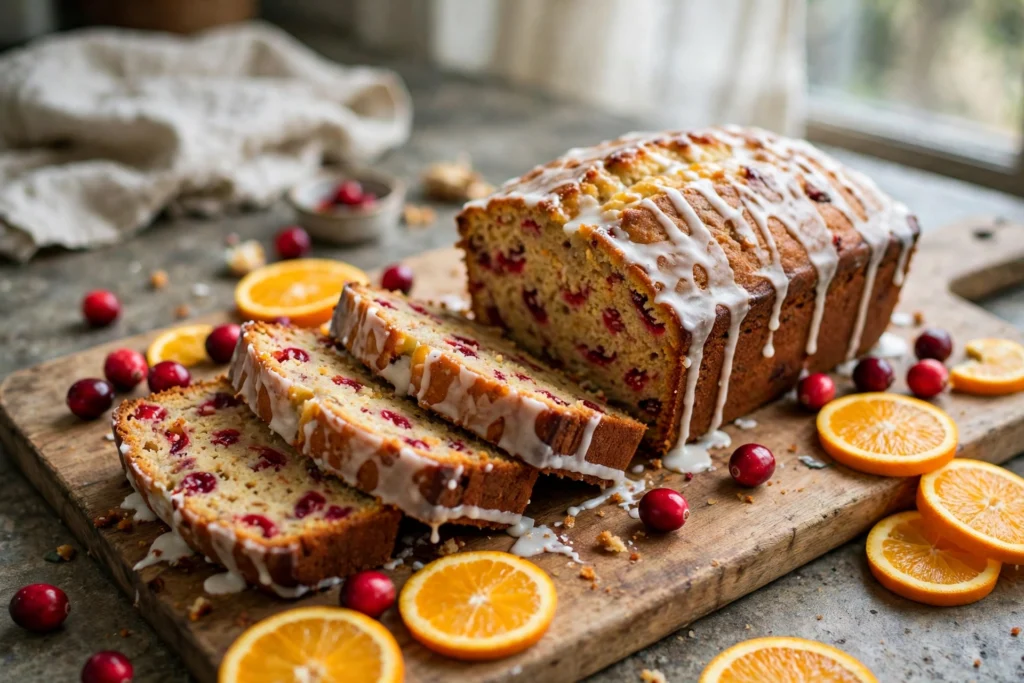
Table of Contents
Why You’ll Love This Cranberry Orange Loaf
- Moist for days, thanks to sour cream and melted butter in the batter.
- The cranberries stay put in every slice, because they are halved and tossed in flour first.
- No mixer needed, and the batter comes together in one bowl in about 20 minutes.
- Fresh or frozen cranberries both work, so you can bake it any time of year.
- The orange glaze sets into a thin, sweet shell that makes the loaf look bakery bought.
- It freezes well, so bake one for now and one for the gift list.
Ingredients You’ll Need
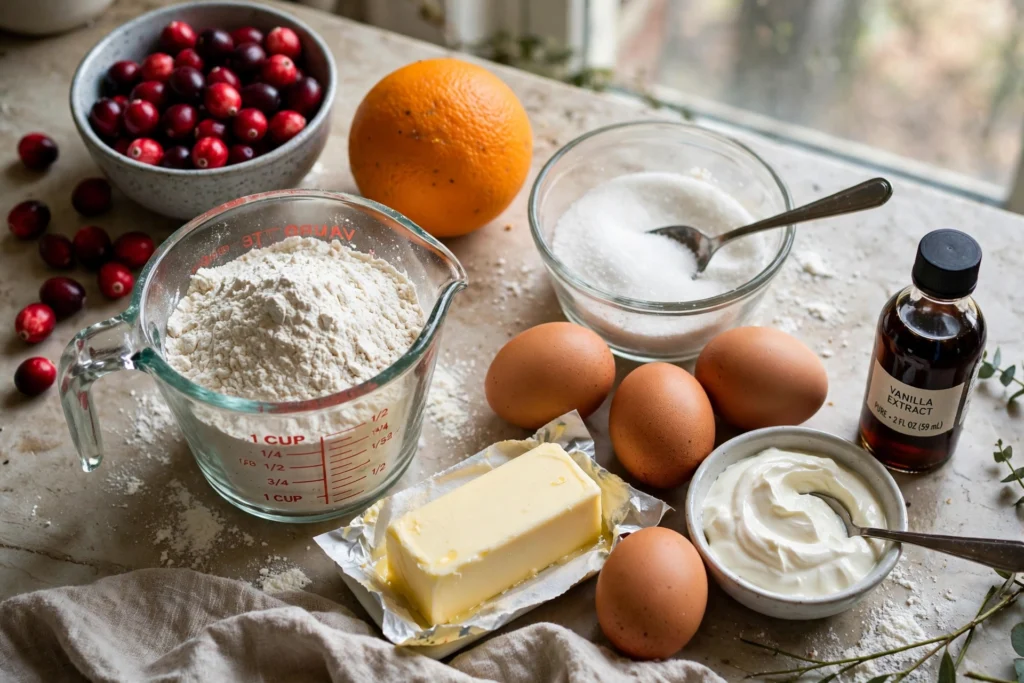
Every ingredient here has a job. Here is what each one does and why it matters, so you can swap with confidence instead of guessing.
All-Purpose Flour
Two cups for the batter, plus one tablespoon set aside for tossing the cranberries. Flour gives the loaf its structure. Spoon it into the measuring cup and level it off with a knife. Scooping straight from the bag packs the flour down and can add a quarter cup or more, which is the most common reason quick bread turns out dry and dense. The extra tablespoon coats the berries and helps them stay suspended in the batter instead of sinking.
Baking Powder and Baking Soda
One teaspoon of baking powder and half a teaspoon of baking soda. This pair lifts the loaf. Baking soda needs an acid to work, and the orange juice and sour cream supply it. Baking powder adds lift on its own. Together they give a tall, even rise without a bitter aftertaste. Measure them level. Too much baking soda leaves a soapy taste and a dark, sunken center.
Salt
Half a teaspoon. Salt sharpens the sweet flavors and balances the tart cranberries. Without it, the loaf tastes flat even with the glaze on top. Fine table salt or fine sea salt both work. If you only have coarse kosher salt, use a generous half teaspoon.
Granulated Sugar
One cup. Sugar sweetens the loaf, but it also does real work. Rubbing it with the orange zest pulls the oils out of the zest, which spreads orange flavor through the whole batter instead of leaving it in little flecks. Sugar also helps the crust brown and keeps the crumb tender by holding moisture.
Orange Zest and Orange Juice
The zest of one large orange, about one tablespoon, plus a quarter cup of fresh juice. Zest carries the orange flavor. Juice adds brightness and the acid the baking soda needs. Use a fresh orange, not bottled juice. Bottled juice tastes flat and misses the oils that make the loaf smell like an orange grove when it bakes. Zest the orange before you cut it for juice.
Unsalted Butter
Half a cup, melted and cooled slightly. Melted butter makes a moist, tender crumb and keeps the mixing simple, since there is no creaming step. Let it cool for a few minutes after melting. Butter that is too hot can cook the eggs when they go in. Unsalted butter lets you control the salt yourself. If you only have salted butter, cut the added salt to a quarter teaspoon.
Eggs
Two large eggs, at room temperature. Eggs bind the batter and add richness. Room-temperature eggs mix in smoothly instead of shocking the melted butter, which keeps the batter even. Set them in a bowl of warm water for 10 minutes if you forgot to take them out early.
Sour Cream
Half a cup. Sour cream is the moisture insurance in this loaf. Its fat keeps the crumb tender, and its tang balances the sweet glaze. Full-fat sour cream works best. Plain Greek yogurt works as a swap, and the loaf will be a little tangier and a touch lighter.
Vanilla Extract
One teaspoon. Vanilla rounds out the flavors so the orange does not taste sharp on its own. It is a background note here, not the star. Pure vanilla extract is best, but imitation vanilla works in a pinch.
Fresh or Frozen Cranberries
One and a half cups, halved. Cranberries bring the tart pops that make this loaf what it is. Halving them matters. Whole berries are heavy and sink, and they burst in big tart pockets. Halved berries spread through the batter and give a tart bite in every slice. Frozen cranberries work straight from the freezer with no thawing. Rinse fresh berries and pat them dry before halving so the flour coating sticks.
Turbinado Sugar (optional topping)
One tablespoon, sprinkled over the batter before baking. Turbinado sugar is coarse and does not melt fully, so it leaves a light crunch on the crust. It is optional, but it gives the loaf a bakery look under the glaze. Regular granulated sugar works, though it melts into the crust instead of crunching.
Powdered Sugar (for the glaze)
Three quarters of a cup. Powdered sugar dissolves into the orange juice without graininess and sets into a thin, sweet shell. Sift it first if it looks lumpy in the bag, since lumps show up as white specks in the glaze.
Recommended Equipment
- 9×5-inch loaf pan
- Parchment paper (for a sling that lifts the loaf out cleanly)
- Large mixing bowl and a medium bowl
- Whisk and a rubber spatula
- Microplane or fine grater (for the orange zest)
- Wire cooling rack
- Toothpick or thin skewer (for testing doneness)
- Instant-read thermometer (optional, but the surest doneness check)
How to Make Cranberry Orange Loaf
1. Heat the oven and prep the pan
Preheat the oven to 350F (175C). Put a rack in the middle position. Line a 9×5-inch loaf pan with parchment paper, leaving an inch of overhang on the two long sides. The overhang works as a sling, so you can lift the loaf out without tipping it. Lightly grease any exposed sides of the pan with butter or cooking spray.
2. Halve the cranberries and toss them in flour
Rinse the cranberries if they are fresh, then pat them dry. Cut each berry in half with a small sharp knife. Frozen berries are easier to cut while still frozen, so do that step first if you are using frozen. Toss the halved berries with one tablespoon of flour in a small bowl until each piece is lightly coated, then set the bowl aside. The flour coating is what keeps the berries from sinking to the bottom of the pan.
3. Whisk the dry ingredients
Whisk the remaining two cups of flour, the baking powder, the baking soda, and the salt together in a large bowl. Whisking spreads the leaveners evenly, so the loaf rises straight instead of lopsided. Set the bowl aside.
4. Rub the orange zest into the sugar
Put the granulated sugar in a medium bowl. Finely grate the zest of one large orange right over the sugar, about one tablespoon. Rub the zest into the sugar with your fingertips for about 30 seconds, until the sugar looks damp and smells strongly of orange. This step pulls the oils out of the zest, and it is the single best way to get real orange flavor into the crumb.
5. Whisk the wet ingredients
Add the melted butter, the eggs, the sour cream, the orange juice, and the vanilla extract to the bowl with the sugar and zest. Whisk until smooth and combined, about 30 seconds. The mixture may look a little loose. That is normal. The sour cream thins the batter, and the flour will bring it back together.
6. Combine the wet and dry ingredients
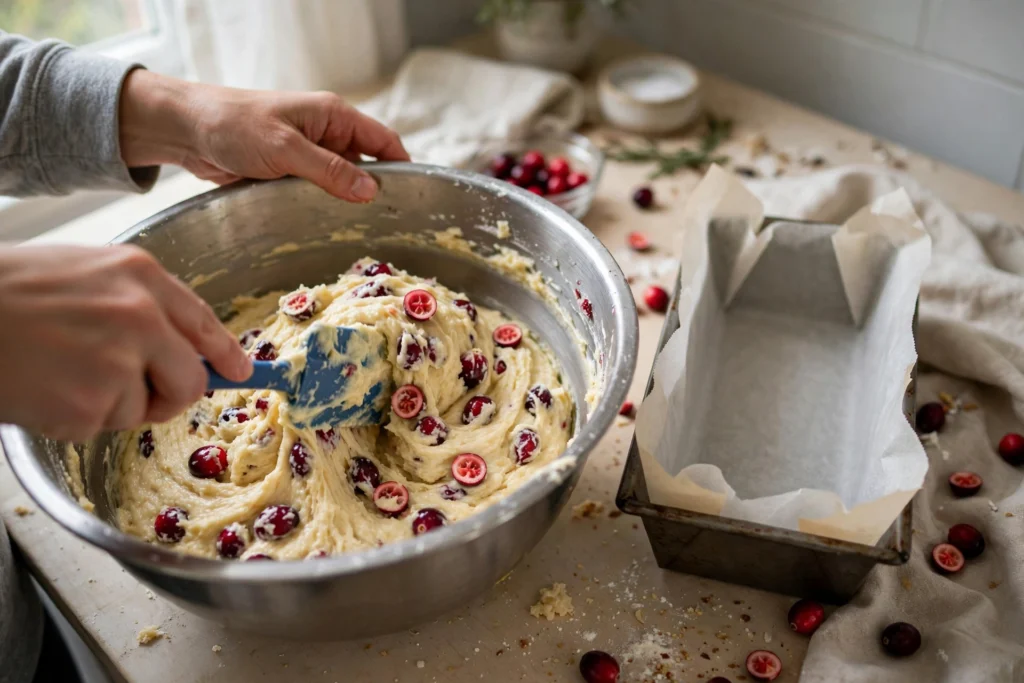
Pour the wet mixture into the bowl of dry ingredients. Stir with a rubber spatula just until you see no more streaks of dry flour. The batter will look thick and a little lumpy. Stop there. Stirring past this point works the flour too hard, and the loaf turns out tough and dense instead of tender.
7. Fold in the cranberries
Add the flour-coated cranberries to the batter. Fold them in gently with the spatula, using wide strokes from the bottom of the bowl, just until the berries are spread through the batter. Count to about ten folds and stop. Overfolding knocks air out of the batter and pushes the berries to the bottom anyway.
8. Fill the pan and add the topping
Scrape the batter into the lined loaf pan. Push it into the corners and smooth the top with the spatula. Sprinkle the turbinado sugar evenly over the top if you are using it. The batter should fill the pan about three quarters full, which leaves room for the rise.
9. Bake until the center tests done
Bake for 50 to 60 minutes. Start checking at 50 minutes. A toothpick pushed into the center should come out with just a few moist crumbs, not wet batter. For the surest check, an instant-read thermometer should read 200F in the center. The top should be golden brown and spring back lightly when pressed. If the top browns too fast before the center is done, tent a sheet of foil loosely over the pan for the last 10 minutes.
10. Cool the loaf in the pan
Set the pan on a wire rack and let the loaf cool in the pan for 15 minutes. The loaf finishes baking from its own heat during this rest, and the crumb sets. After 15 minutes, lift the loaf out with the parchment sling and set it on the rack to cool completely, about 1 hour. Slicing a warm loaf crushes the crumb and lets steam escape, which dries the slices out.
11. Mix and drizzle the orange glaze
Whisk the powdered sugar with one and a half tablespoons of orange juice and half a teaspoon of orange zest until smooth. The glaze should pour off the spoon in a slow ribbon. If it is too thick, add juice a few drops at a time. If it is too thin, whisk in a spoonful more powdered sugar. Drizzle the glaze over the fully cooled loaf and let it set for about 15 minutes before slicing. Glazing a warm loaf melts the glaze into the crust instead of letting it set on top.
Pro Tips for a Perfect Cranberry Orange Loaf
Halve the berries, every time. Whole cranberries are heavy for this batter, and they sink. Halving them cuts the weight in each piece and doubles the number of tart pops in every slice. It takes five minutes and it is the difference between a loaf that looks studded and a loaf with a berry layer at the bottom.
Do not skip the flour toss. The tablespoon of flour on the berries works with the halving to hold them in place. Shake off the extra flour before folding them in, so the batter does not pick up dry clumps.
Rub the zest into the sugar. Zest stirred straight into batter gives little bursts of orange in some bites and none in others. Rubbing it into the sugar first spreads the orange oil through the whole loaf. You can smell the difference the second the loaf goes in the oven.
Stop mixing while the batter still looks lumpy. A few small lumps are fine. They bake out. A smooth, glossy batter means the flour was overworked, and the loaf will be tough. Count your strokes and stop at no dry flour.
Check doneness two ways. The toothpick test tells you the center is not wet. The thermometer tells you it is fully baked. A loaf pulled at 190F looks done and eats gummy in the middle. At 200F, the crumb is set and moist. If you only have a toothpick, look for a few moist crumbs and a top that springs back.
Cool completely before glazing. The glaze needs a cool surface to set into a shell. On a warm loaf it melts, soaks in, and leaves a sticky top instead of a pretty drizzle. One hour on the rack is worth the wait.
Variations
Cranberry Orange Muffins
Spoon the same batter into a lined 12-cup muffin tin, filling each cup about three quarters full. Sprinkle with turbinado sugar and bake at 375F for 20 to 25 minutes, until a toothpick comes out with a few moist crumbs. The muffins bake faster and make easy grab-and-go breakfasts or lunchbox treats. Glaze them once cool, or leave them plain.
Pecan Cranberry Orange Loaf
Fold in half a cup of chopped toasted pecans with the cranberries. Toast the pecans in a dry pan over medium heat for 3 to 4 minutes, until they smell nutty, then cool them before adding. The nuts add crunch and a warm flavor that suits the holiday table. Walnuts work the same way.
Cranberry Orange Loaf with Streusel
Skip the glaze and add a streusel top instead. Mix a third of a cup of flour, a quarter cup of brown sugar, a quarter teaspoon of cinnamon, and 3 tablespoons of cold butter cut into small pieces until crumbly, then sprinkle it over the batter before baking. The streusel bakes into a crisp, spiced crust. This version is best the day it is baked, since the streusel softens overnight.
Double Orange Loaf
Add half a teaspoon of orange extract with the vanilla, and use the zest of a second orange in the glaze. The orange flavor turns up a notch without extra sweetness. This version suits readers who find the standard loaf a little mild on citrus.
Mini Loaves for Gifting
Divide the batter between three greased mini loaf pans, about 5×3 inches each. Bake at 350F for 30 to 35 minutes, until a toothpick tests clean. Cool, glaze, and wrap each loaf in parchment and twine. One batch makes three gift loaves, and they freeze well for up to 2 months.
Ingredient Substitutions
No sour cream? Plain Greek yogurt is the closest swap, cup for cup. The loaf will be a little tangier and a touch lighter. Buttermilk also works, but it is thinner, so the batter will be looser and the loaf may bake a few minutes longer. Do not use light sour cream. It has more water and less fat, and the crumb turns out damp instead of moist.
No fresh oranges? A second orange is worth buying, because bottled juice and dried zest both fall short. In a real pinch, use a quarter cup of bottled orange juice and half a teaspoon of orange extract. The loaf will still bake, but the orange flavor will be quieter and the glaze will taste sweeter.
No fresh or frozen cranberries? Dried cranberries work, but they change the loaf. Soak one cup of dried cranberries in hot water for 10 minutes, drain them well, and fold them in. They are sweeter than fresh berries, so cut the granulated sugar to three quarters of a cup. The loaf will be sweeter and less tart, and the color will be deeper red.
No turbinado sugar? Skip the topping or use a spoonful of granulated sugar. It melts into the crust instead of crunching, but the flavor stays the same. Coarse sparkling sugar from the baking aisle works the same as turbinado.
Butter swap? A neutral oil, like vegetable or canola oil, can replace the butter cup for cup. The crumb stays moist, but you lose the butter flavor and the crust browns a little less. Olive oil is not a good fit here. Its flavor fights the orange.
Dietary Notes
This loaf is vegetarian. It is not gluten-free, dairy-free, or nut-free as written, and the notes below cover honest swaps rather than promises.
For a gluten-free version, use a cup-for-cup gluten-free flour blend with xanthan gum already in it. The crumb will be a little more delicate, so let the loaf cool fully in the pan before lifting it out. Bake time stays about the same, but check doneness with a thermometer, since gluten-free crumbs can look done before they are set.
For a dairy-free version, swap the butter for a neutral oil and the sour cream for a plain coconut yogurt. The loaf will be moist and tender, with a very faint coconut note in the background. Check the glaze too, since powdered sugar is dairy-free on its own, so the glaze needs no change.
The recipe is nut-free as written, as long as you skip the pecan variation. The standard loaf contains wheat, eggs, and milk, so it does not suit wheat, egg, or milk allergies without a full rework of the batter.
Make-Ahead, Storage & Freezing
Make ahead: The loaf bakes best the day you serve it, but you can mix the dry ingredients the night before and store them in a covered bowl. In the morning, whisk the wet ingredients, combine, fold in the berries, and bake. The batter itself should not sit overnight once mixed, because the baking soda starts working as soon as it meets the wet ingredients, and the loaf will not rise as well the next day.
Storage: Once the glaze has set, wrap the cooled loaf tightly in plastic wrap and keep it at room temperature for up to 3 days. The crumb actually gets more moist on day two, as the cranberries release a little of their juice into the crumb. If your kitchen is warm, store the loaf in the fridge instead, where it keeps for up to 5 days. Bring slices back to room temperature before serving, or warm them for 10 seconds in the microwave.
Freezing: This loaf freezes well for up to 3 months. Freeze it unglazed for the best result. Wrap the fully cooled loaf tightly in plastic wrap, then in foil, and label it with the date. Thaw at room temperature for about 3 hours, then glaze and slice. You can also freeze individual slices in a sealed freezer bag with parchment between them, so you can pull out one slice at a time for breakfast.
Reheating: Warm a slice in a 300F oven for 5 to 7 minutes, or in the microwave for about 15 seconds. The oven keeps the crust crisp. The microwave softens it, which suits a slice served with butter. Do not reheat the whole glazed loaf in the oven. The glaze will melt and slide off.
What to Serve With Cranberry Orange Loaf
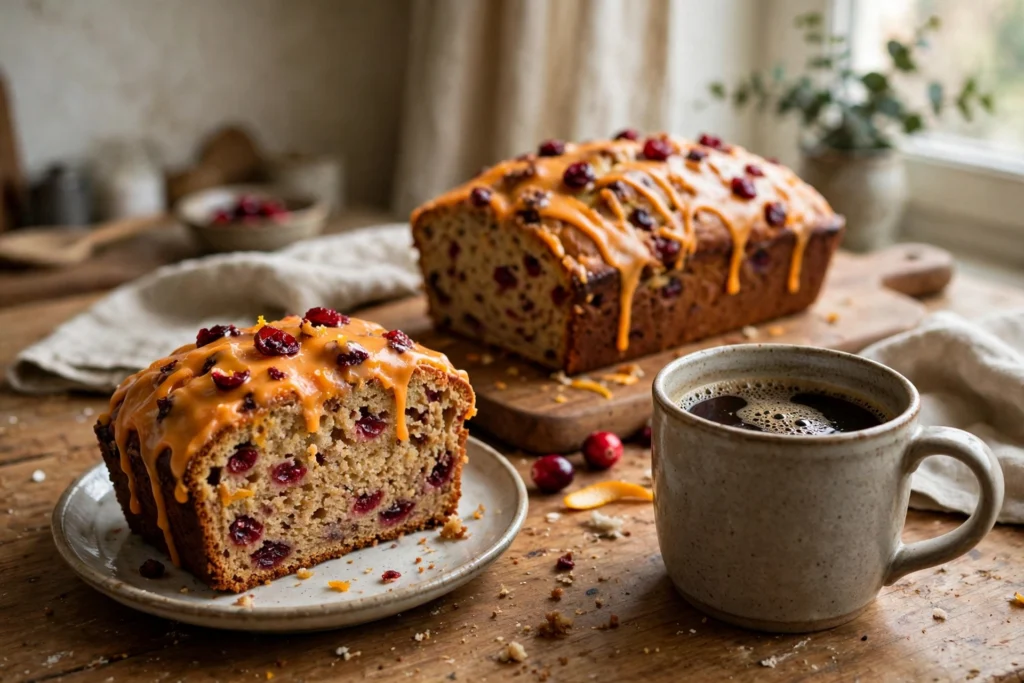
This loaf is at home on a holiday breakfast table, next to scrambled eggs and bacon, where its sweet-tart slices balance the salty food. It also works as an afternoon snack with coffee or tea, cut thick and served plain or with a smear of butter.
For a fuller holiday spread, pair it with our KFC-style crispy fried chicken the night before, then serve the loaf for breakfast the next morning. The two recipes share the same crowd-pleasing, made-from-scratch spirit. On a Thanksgiving or Christmas dessert table, it sits well beside our pumpkin cheese ball as the sweet finish after the savory snacks. And if you are building a Halloween or fall party spread, our mummy hot dogs cover the fun, kid-friendly side while the loaf covers the grown-ups.
A pot of coffee, a jug of orange juice, or a mug of hot cocoa all pair well with a slice. For a simple gift, wrap a cooled, glazed loaf in parchment, tie it with twine, and tuck in a sprig of fresh rosemary.
Recipe Notes
- Halve the cranberries and toss them in flour. This is the step that keeps them spread through the loaf.
- Rub the orange zest into the sugar for 30 seconds. That is where the orange flavor comes from.
- Stop mixing as soon as the dry flour disappears. A lumpy batter bakes into a tender loaf.
- Bake to 200F in the center, or until a toothpick comes out with a few moist crumbs.
- Cool the loaf fully before glazing, or the glaze will melt into the crust.
- Frozen cranberries go in straight from the freezer. Do not thaw them first, and add 5 minutes to the bake time.
- The loaf tastes even better on day two, once the cranberries soften into the crumb.

Cranberry Orange Loaf (Moist & Easy!)
Description
A moist cranberry orange loaf with tart fresh cranberries, bright orange zest, and a sweet orange glaze. Halved berries stay suspended in every slice, and the crumb stays tender for days.
For the cranberry orange loaf
For the orange glaze
Instructions
-
Heat the oven and prep the pan
Preheat the oven to 350F (175C) with a rack in the middle position. Line a 9x5-inch loaf pan with parchment paper, leaving an inch of overhang on the two long sides, and lightly grease any exposed sides. -
Halve the cranberries and toss them in flour
Rinse fresh cranberries and pat dry, or cut frozen cranberries while still frozen. Halve each berry and toss with 1 tablespoon of flour until lightly coated. Set aside. -
Whisk the dry ingredients
Whisk the remaining 2 cups of flour, the baking powder, the baking soda, and the salt together in a large bowl until evenly combined. -
Rub the orange zest into the sugar
Put the granulated sugar in a medium bowl, grate the orange zest over it, and rub the zest into the sugar with your fingertips for about 30 seconds, until the sugar smells strongly of orange. -
Whisk the wet ingredients
Add the melted butter, eggs, sour cream, orange juice, and vanilla extract to the sugar and zest. Whisk until smooth, about 30 seconds. -
Combine the wet and dry ingredients
Pour the wet mixture into the dry ingredients and stir with a rubber spatula just until no streaks of dry flour remain. The batter will look thick and a little lumpy. -
Fold in the cranberries
Add the flour-coated cranberries and fold gently with the spatula, about ten folds, until the berries are spread through the batter. -
Fill the pan and add the topping
Scrape the batter into the lined loaf pan, push it into the corners, and smooth the top. Sprinkle the turbinado sugar evenly over the top if using. -
Bake until the center tests done
Bake 50 to 60 minutes, starting to check at 50 minutes. A toothpick inserted in the center should come out with a few moist crumbs, and an instant-read thermometer should read 200F. Tent foil loosely over the pan for the last 10 minutes if the top browns too fast. -
Cool the loaf in the pan
Set the pan on a wire rack for 15 minutes, then lift the loaf out with the parchment sling and cool completely on the rack, about 1 hour. -
Mix and drizzle the orange glaze
Whisk the powdered sugar with 1 1/2 tablespoons of orange juice and the orange zest until smooth, adding juice a few drops at a time if needed. Drizzle over the fully cooled loaf and let set about 15 minutes before slicing.
Nutrition Facts
Servings 10
- Amount Per Serving
- Calories 330kcal
- % Daily Value *
- Total Fat 13g20%
- Saturated Fat 8g40%
- Sodium 180mg8%
- Total Carbohydrate 52g18%
- Dietary Fiber 1g4%
- Sugars 38g
- Protein 4g8%
* Percent Daily Values are based on a 2,000 calorie diet. Your daily value may be higher or lower depending on your calorie needs.
Note
Halve the cranberries and toss them in flour so they stay suspended in every slice.
Rub the orange zest into the sugar for 30 seconds. That is where the orange flavor comes from.
Stop mixing as soon as the dry flour disappears. A lumpy batter bakes into a tender loaf.
Bake to 200F in the center, or until a toothpick comes out with a few moist crumbs.
Cool the loaf fully before glazing, or the glaze will melt into the crust.
Frozen cranberries go in straight from the freezer. Do not thaw them first, and add 5 minutes to the bake time.
The loaf tastes even better on day two, once the cranberries soften into the crumb.
The batter contains raw eggs and raw flour. Do not eat raw batter.
Bake until the center reaches 200F or a toothpick comes out with only a few moist crumbs.
The finished loaf contains eggs, milk, and butter. Do not leave it at room temperature for more than 2 hours in a warm kitchen. Refrigerate leftovers.
Frozen cranberries should be kept frozen until they go into the batter. Do not thaw and refreeze them.
Nutrition is an estimate calculated from the ingredients listed above. Values will shift a little with different brands and slice size.