


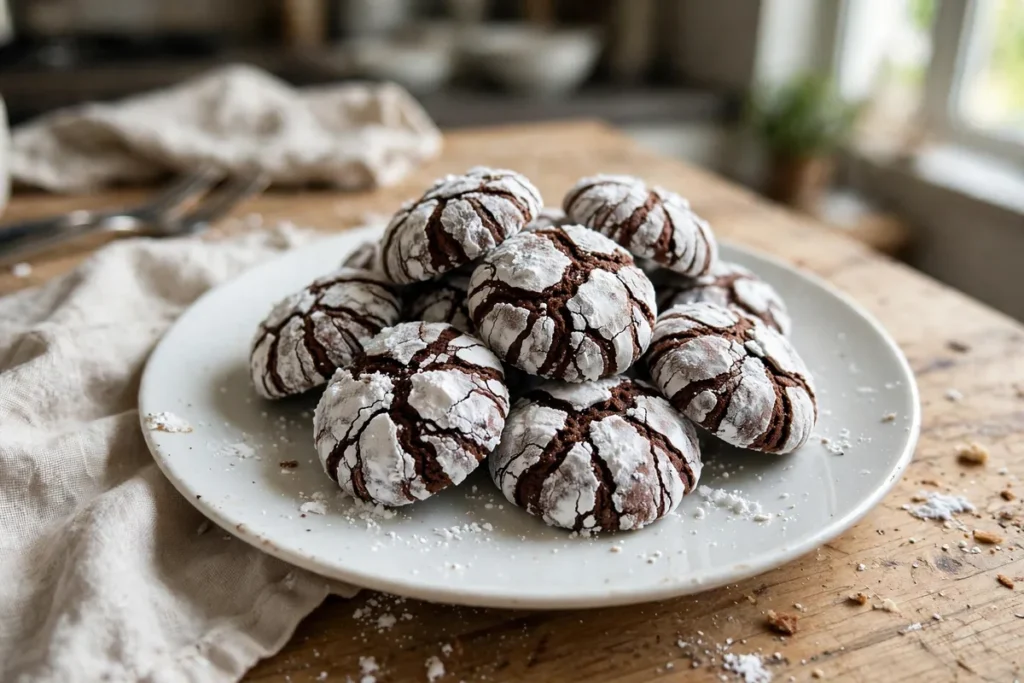
Chocolate crinkle cookies are soft, fudgy chocolate cookies rolled in sugar and baked until the tops crack open into white plates over dark chocolate. This version takes 2 hours 30 minutes in total, including a 2 hour chill, and makes 28 cookies. The centers stay soft and almost brownie like, while the outside keeps a bright white crackle that does not turn grey in the oven.
The trick is simple, and it fixes the two complaints that show up again and again in search results. First, the dough goes into the fridge until it is properly firm, not just cool on the surface. Second, each cold ball gets rolled twice: once lightly in granulated sugar, then thickly in powdered sugar. That first layer pulls surface moisture away from the dough, so the powdered sugar sits on top instead of soaking in. When the cookie spreads in the oven, the dry sugar skin breaks into clean cracks.
You do not need a mixer, melted chocolate, or a candy thermometer. A whisk, two bowls, and a cookie scoop cover the whole job. The dough mixes in about 20 minutes. Most of the total time is hands off chill time, which makes this an easy bake to fit around other Christmas prep. Mix the dough in the morning, bake in the afternoon, and pack the cookies for a cookie exchange the same day.
Table of Contents
Why You’ll Love These Chocolate Crinkle Cookies
- The centers stay fudgy because the bake time stops while the middle still looks soft, and the cookies finish setting on the hot pan.
- The crackle stays white because the double sugar roll keeps the powdered sugar from dissolving into the dough.
- The recipe uses pantry cocoa and oil, so there is no chocolate to melt and no waiting for a butter and chocolate mixture to cool.
- One batch makes 28 cookies, enough for a cookie tray plus a small box to give away.
- The dough holds well in the fridge for up to 3 days, so you can mix ahead and bake fresh on the day you need them.
- The base takes simple variations well, from peppermint for Christmas to a pinch of cinnamon for a Mexican chocolate turn.
Ingredients You’ll Need
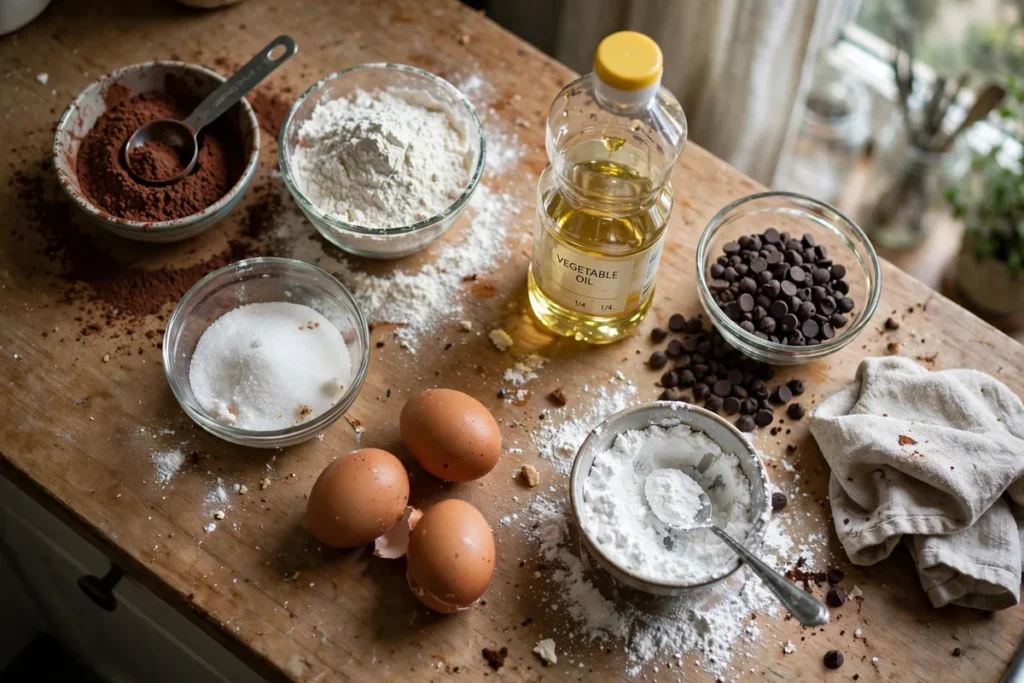
A crinkle cookie lives or dies on balance. Too much flour and the cookie turns cakey. Too little chill and it spreads flat. This list keeps the dough soft enough to stay fudgy and firm enough to hold a thick sugar coat.
Granulated Sugar and Brown Sugar
One cup of granulated sugar and 1/4 cup of packed light brown sugar sweeten the dough and help the tops crack. Brown sugar adds a little moisture, which helps the center stay soft after baking. Keep the two sugars separate from the coating sugars until the rolling step, or the coating bowl will run short.
Vegetable Oil
A 1/4 cup of neutral vegetable oil gives the dough its fudgy texture. Oil coats flour differently than butter does, and it keeps the baked cookie soft for days. Use a neutral oil with no strong flavor, such as vegetable, canola, or light sunflower oil. Olive oil with a strong taste will show through the chocolate.
Eggs
Two large eggs bind the dough and add richness. Room temperature eggs mix more evenly into the oil and sugar, so set them out while you measure the dry ingredients. Cold eggs straight from the fridge still work, but the mixture may look slightly uneven until the flour goes in.
Vanilla Extract and Espresso Powder
One teaspoon of vanilla extract rounds out the chocolate flavor. A 1/2 teaspoon of instant espresso powder is optional, and it does not make the cookies taste like coffee. It deepens the chocolate flavor in the same way a pinch of salt sharpens sweetness. Leave it out if you do not have it. The cookies still taste properly chocolatey without it.
All Purpose Flour, Cocoa Powder, Baking Powder, and Salt
One cup of all purpose flour, 1/2 cup of unsweetened cocoa powder, 1 teaspoon of baking powder, and 1/4 teaspoon of salt form the dry base. Spoon the flour into the measuring cup and level it off, or weigh it at 120 grams. Scooping straight from the bag packs extra flour into the cup, and that extra flour is a common cause of dry, cakey crinkles. Use natural unsweetened cocoa powder, not Dutch process, since this recipe uses baking powder. Sift the cocoa if it looks lumpy. Lumps in the cocoa show up as dark specks in the finished cookie.
Mini Chocolate Chips
A 1/2 cup of mini chocolate chips melts into small pockets through the center. Mini chips spread more evenly than regular chips in a small cookie, so every bite gets a little melted chocolate. Regular chips work too, but they can push the small balls out of shape. Keep the chips in the fridge until you need them if your kitchen is warm.
Coating Sugars
The coating uses 1/4 cup of granulated sugar for the first roll and 1 cup of powdered sugar, sifted, for the second roll. The granulated layer is thin. Its job is to act as a dry barrier between the moist dough and the powdered sugar. The powdered layer should be thick and complete, with no dark dough showing through before the cookies go into the oven. Sift the powdered sugar into a shallow bowl so the coating goes on evenly.
Recommended Equipment
- Two mixing bowls, one medium and one large
- Whisk and a sturdy spatula
- Measuring cups and spoons, or a kitchen scale
- Small sifter or fine mesh sieve for the powdered sugar
- 1 1/2 tablespoon cookie scoop
- Two baking sheets lined with parchment paper
- Wire cooling rack
- Shallow bowls for the two coating sugars
How to Make Chocolate Crinkle Cookies
1. Whisk the dry ingredients
Whisk the flour, cocoa powder, baking powder, salt, and espresso powder if you use it in a medium bowl until the mixture looks even in color. Break up any cocoa lumps with the whisk. Set the bowl aside. Mixing the dry ingredients first means the cocoa and baking powder spread evenly, so no cookie ends up with a bitter pocket or a flat spot.
2. Whisk the wet ingredients
Whisk the granulated sugar, brown sugar, and oil in a large bowl until the mixture looks smooth and slightly thick, about 1 minute. Add the eggs one at a time and whisk well after each one. Stir in the vanilla. The mixture should look glossy and uniform before the flour goes in. If the oil separates a little at the edges, keep whisking for another 30 seconds.
3. Mix the dough and add the chocolate chips
Add the dry ingredients to the wet ingredients in two parts, stirring with a spatula after each part until just combined. Stop as soon as the last streak of flour disappears. Overmixing builds gluten and turns a fudgy cookie cakey. Fold in the mini chocolate chips. The dough will look soft, sticky, and almost like thick brownie batter. That softness is correct. Do not add extra flour to make it easier to handle. The fridge will fix the texture.
4. Chill the dough until firm
Cover the bowl tightly and refrigerate for at least 2 hours, or overnight. The dough should feel firm enough to scoop and roll without sticking badly to your hands. If the dough still feels soft after 2 hours, give it another 30 minutes. Warm dough spreads too fast in the oven, and the sugar coating slides off the sides. Cold dough spreads slowly, which gives the sugar skin time to crack instead of melt. While the dough chills, line the baking sheets with parchment paper and sift the powdered sugar into a shallow bowl.
5. Roll the dough balls in two sugars
Heat the oven to 350 degrees Fahrenheit and place a rack in the center of the oven. Put the granulated coating sugar in one shallow bowl and the sifted powdered sugar in another. Scoop 1 1/2 tablespoons of cold dough per cookie and roll it quickly into a ball with lightly oiled or cool hands. Roll each ball first in the granulated sugar, shaking off the excess, then roll it generously in the powdered sugar until it looks completely white. Place the balls 2 inches apart on the prepared sheets. Work with one tray at a time and keep the rest of the dough in the fridge. Coated balls left sitting on the counter absorb moisture, and the powdered sugar starts to disappear before baking.

6. Bake until the edges set and the centers stay soft
Bake one sheet at a time for 10 to 12 minutes. The cookies should puff, spread, and crack across the top. The edges will look set while the centers still look slightly soft between the cracks. That soft look is the doneness cue. Pull the tray out at that point, even if the centers look underdone. The cookies firm up as they cool, and an extra minute in the oven is the difference between fudgy and dry. If your oven runs hot, check the first tray at 9 minutes.
7. Cool on the pan, then on a rack
Leave the cookies on the baking sheet for 5 minutes. They are soft and fragile straight from the oven, and they will break if moved too soon. Transfer them gently to a wire rack with a thin spatula and cool completely, about 20 minutes. Store only after they feel cool to the touch. Warm cookies in a closed container steam the sugar coating and turn it grey.
Pro Tips for Snowy Cracks and Fudgy Centers
Keep the dough cold between batches. Scoop and roll one tray, bake it, and only then take the bowl out again for the next tray. Warm dough is the main reason a second tray spreads flatter than the first.
Use plenty of powdered sugar. A light dusting looks pretty in the bowl and vanishes in the oven. Each ball should look thickly white, with no dark patches, before it goes on the tray. If a ball loses its coat while you handle it, roll it in powdered sugar a second time.
Bake one sheet at a time on the center rack. Two sheets in the oven at once bake unevenly, and the lower tray often ends up with less crackle. The extra time is worth it for a full batch that looks the same from first tray to last.
Measure flour by spooning and leveling, or by weight. Flour is the ingredient most often overmeasured in home baking, and the extra flour dries out crinkle cookies more than any other single mistake.
Do not flatten the balls. Crinkle cookies need height to crack well. A flattened ball spreads into a thin cookie with shallow cracks and a dry center. Place the round balls on the tray as they are and let the oven do the shaping.
Watch the first tray closely and write down the time that works in your oven. Ovens vary by 25 degrees or more, and that gap changes a crinkle cookie fast. Once you know your time, usually 10 or 11 minutes, the rest of the batch is easy.
Troubleshooting: Why Crinkle Cookies Go Wrong
Flat cookies usually come from warm dough, too little flour, or a hot baking sheet. Chill the dough until firm, measure flour by spooning and leveling, and let the sheet cool between batches. A sheet that goes back into the oven while still warm melts the next tray before the sugar skin can set.
Grey or vanished sugar usually comes from a thin coat, a long wait between coating and baking, or humidity. Roll in granulated sugar first, then thickly in powdered sugar, and bake right after coating. On a humid day, roll the balls just before the tray goes in and keep the powdered sugar bowl covered between trays.
Few cracks usually come from dough that was too warm or a coat that was too thin. Chill longer, roll the balls cold, and coat thickly. If the first tray shows shallow cracks, add more powdered sugar to the next tray and check that the dough went back into the fridge between trays.
Dry centers usually come from overbaking. Take the cookies out while the centers still look soft between the cracks. They will look underdone for about 5 minutes on the pan, then set into a fudgy center. A cookie that looks fully firm in the oven will taste dry once cool.
Cakey texture usually comes from overmixing or too much flour. Stir only until the flour disappears, and measure flour carefully. The dough should look like thick brownie batter before chilling, not like firm cookie dough.
Uneven sizes bake unevenly, so use a scoop. Cookies of different sizes on one tray mean the small ones dry out while the large ones finish. A 1 1/2 tablespoon scoop keeps the batch even and gives 28 cookies from this recipe.
Variations
Peppermint Chocolate Crinkle Cookies
Add 1/4 teaspoon of peppermint extract with the vanilla, and fold in 1/4 cup of crushed candy canes with the chocolate chips. Keep the peppermint light. Peppermint extract is strong, and 1/4 teaspoon flavors the whole batch without tasting like toothpaste. These suit a Christmas cookie tray and pair well with plain sugar cookies for color contrast.
Double Chocolate Crinkle Cookies
Increase the mini chocolate chips to 3/4 cup and add 1 tablespoon of extra cocoa powder, reducing the flour by 1 tablespoon to keep the balance. The result tastes closer to a brownie, with a darker crumb and more melted chocolate. Chill an extra 30 minutes, since the extra chips soften the dough.
Mexican Chocolate Crinkle Cookies
Add 1/2 teaspoon of ground cinnamon and a tiny pinch of cayenne pepper to the dry ingredients. The cinnamon warms the chocolate flavor, and the cayenne stays in the background. Taste the dough for heat before baking, since cayenne brands vary. Skip the cayenne for a kid friendly version and keep the cinnamon.
Orange Chocolate Crinkle Cookies
Add 1 teaspoon of finely grated orange zest to the wet ingredients. Orange and chocolate pair well, and the zest gives the cookie a fresh edge that suits a winter dessert table. Do not add orange juice to the dough. Liquid thins the dough and weakens the crackle.
Nutty Chocolate Crinkle Cookies
Fold in 1/2 cup of finely chopped toasted walnuts or pecans with the chocolate chips. Chop the nuts fine, or the balls will crack apart when rolled. Nuts add crunch to a soft cookie, but they also absorb a little moisture, so pull the tray out at the earlier end of the bake time.
Ingredient Substitutions
No vegetable oil on hand? Melted and cooled coconut oil works in the same amount, but chill the dough for a full 2 hours and keep it cold between batches. Coconut oil softens faster at room temperature than vegetable oil, so warm dough spreads more quickly.
No mini chocolate chips? Chop a chocolate bar into small pieces, or use regular chocolate chips and press any large pieces back into the balls while rolling. The cookie still cracks the same way. The chips are a texture extra, not the structure of the dough.
No espresso powder? Leave it out. The cookies lose a little depth but keep their chocolate flavor. Do not replace it with brewed coffee, which adds liquid and thins the dough.
No powdered sugar for the coat? The classic white crackle needs powdered sugar, so this swap changes the look. A cinnamon sugar coat makes a tasty snickerdoodle style cookie, but it will not crack white. Granulated sugar alone gives a sparkly top with shallow cracks.
Egg free baking needs a different dough balance, so this recipe does not convert well with a single egg swap. The eggs carry much of the structure here. For an egg free chocolate cookie, use a recipe built for that purpose rather than forcing this dough to work.
Gluten free flour blends vary too much to promise one result here. A blend with xanthan gum, measured by weight at 120 grams, gives the closest result. Expect a slightly more delicate cookie and a shorter chill, so check firmness at 90 minutes.
Dietary Notes
These cookies are vegetarian as written, with eggs and no gelatin. They contain wheat, egg, and soy in most chocolate chips, so they do not suit wheat free, egg free, or dairy free diets without a recipe built for those needs. Check the chocolate chip label for milk and soy if you bake for guests with allergies. The recipe contains no nuts as written, which helps for nut free cookie trays, but check labels for shared equipment warnings if nut allergy is a concern.
For a lighter tray, serve smaller cookies by scooping 1 tablespoon per cookie and baking for 9 to 10 minutes. The batch then makes about 36 smaller cookies. The centers stay soft, and the smaller size suits a mixed cookie box where guests taste several kinds.
Make-Ahead, Storage, and Freezing
Make ahead: mix the dough and refrigerate it, covered, for up to 3 days. The flavor holds well, and the dough may even taste slightly deeper after a day. Roll and coat the balls only when you are ready to bake, since a coated ball left in the fridge absorbs moisture and loses its white coat.
Storage: cool the cookies completely, then store them in an airtight container at room temperature for up to 5 days. Place parchment paper between layers so the sugar coats do not rub off. The centers stay soft for about 3 days and firm up slowly after that. Do not refrigerate baked cookies. Cold storage dries them out and dulls the sugar coat.
Freezing baked cookies: freeze cooled cookies in a single layer on a tray, then transfer them to a freezer bag for up to 3 months. Thaw at room temperature for about 30 minutes. If the sugar coat looks dull after thawing, roll the cookies lightly in fresh sifted powdered sugar before serving. The texture will be close to fresh, though slightly less soft.
Freezing dough: scoop the dough into balls, freeze them uncoated on a tray, then bag them for up to 3 months. Roll the frozen balls in granulated sugar, then in powdered sugar, and bake straight from frozen, adding 1 to 2 minutes to the bake time. This is the best way to bake fresh crinkles for a party without a full prep day.
Cookie box timing: bake the cookies the day before a cookie exchange if you need them to travel, or the morning of the event for the softest centers. Pack them once fully cool, in a single layer where possible, and keep the box at room temperature. A box packed warm steams the sugar off every cookie inside.
What to Serve With Chocolate Crinkle Cookies
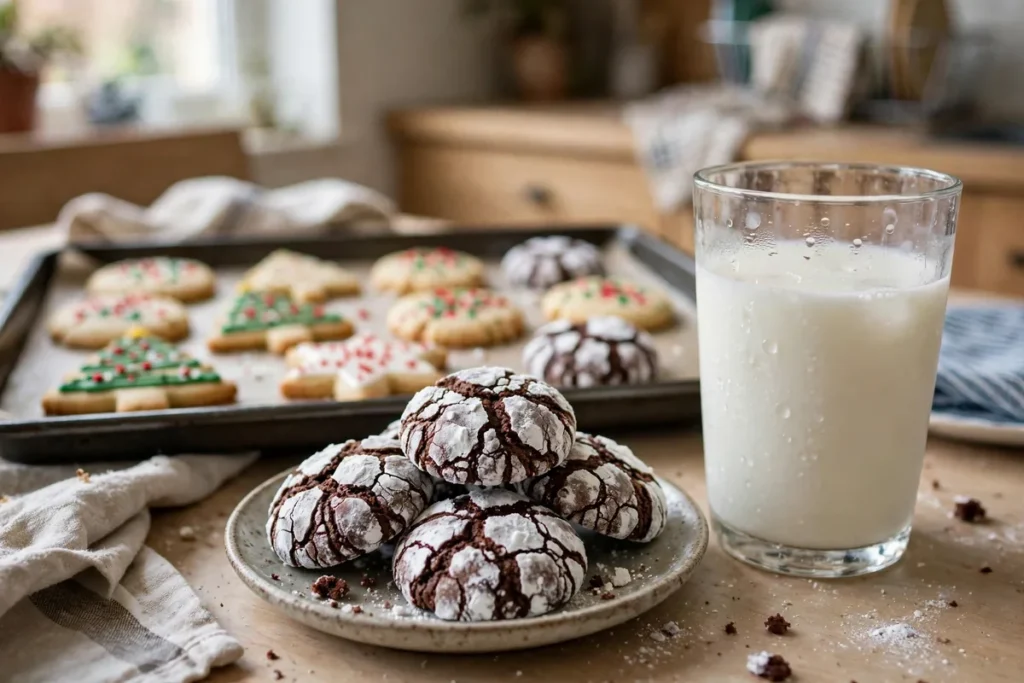
Crinkle cookies suit a Christmas cookie tray, a cookie exchange box, or a simple dessert plate after a holiday meal. Their dark color and white cracks look best next to pale cookies, such as sugar cookies or shortbread, and a red accent such as a peppermint cookie or a cranberry sweet.
For a full holiday party table, start savory before the sweets. Our Pumpkin Cheese Ball makes a festive appetizer that guests can snack on while cookies bake, and our Mummy Hot Dogs suit a casual party spread with kids at the table. For a heartier main dish at the same gathering, our KFC-style crispy fried chicken gives guests something substantial before dessert. Serve the crinkle cookies with cold milk, hot chocolate, or black coffee. Coffee suits the chocolate best, and it cuts the sweetness of the sugar coat.
Recipe Notes
- Chill the dough until firm, at least 2 hours, or the cookies spread flat.
- Roll cold balls first in granulated sugar, then thickly in powdered sugar, for a white crackle that stays white.
- Bake one sheet at a time and pull the tray out while the centers still look soft.
- Cool the cookies on the pan for 5 minutes before moving them to a rack.
- Store cooled cookies at room temperature for up to 5 days, or freeze the uncoated dough balls for up to 3 months.
- Measure flour by spooning and leveling, or weigh 120 grams, to keep the centers fudgy.
For another Christmas treat, try our peppermint bark alongside these crinkle cookies.
Chocolate Crinkle Cookies — Fudgy Centers, Snowy Crackles
Description
Soft, fudgy chocolate cookies rolled twice in sugar and baked until the tops crack into snowy white plates over dark chocolate. Cold dough and a double sugar roll keep the coating bright and the centers soft.
Ingredients
Instructions
-
Whisk the dry ingredients
Whisk the flour, cocoa powder, baking powder, salt, and espresso powder if using in a medium bowl until even in color.
-
Whisk the wet ingredients
Whisk the granulated sugar, brown sugar, and oil in a large bowl until the mixture looks smooth and slightly thick, about 1 minute. Add the eggs one at a time and whisk well after each one. Stir in the vanilla. The mixture should look glossy and uniform before the flour goes in. If the oil separates a little at the edges, keep whisking for another 30 seconds.
-
Mix the dough and add the chocolate chips
Add the dry ingredients to the wet ingredients in two parts, stirring just until the flour disappears, then fold in the mini chocolate chips. The dough will be soft and sticky. -
Chill the dough until firm
Cover the bowl tightly and refrigerate for at least 2 hours, or overnight, until firm enough to scoop and roll. -
Roll the dough balls in two sugars
Heat the oven to 350 degrees Fahrenheit (175 degrees Celsius), scoop 1 1/2 tablespoons of cold dough per cookie, roll into a ball, roll first in granulated sugar, then generously in powdered sugar until completely white, and place 2 inches apart on parchment lined sheets. Keep the remaining dough in the fridge between trays. -
Bake until the edges set and the centers stay soft
Bake one sheet at a time for 10 to 12 minutes, until the tops crack, the edges look set, and the centers still look slightly soft between the cracks. -
Cool on the pan, then on a rack
Leave the cookies on the sheet for 5 minutes, transfer gently to a wire rack, and cool completely before storing.
Nutrition Facts
Servings 28
- Amount Per Serving
- Calories 135kcal
- % Daily Value *
- Total Fat 6g10%
- Saturated Fat 2g10%
- Sodium 65mg3%
- Total Carbohydrate 20g7%
- Dietary Fiber 1g4%
- Sugars 14g
- Protein 2g4%
* Percent Daily Values are based on a 2,000 calorie diet. Your daily value may be higher or lower depending on your calorie needs.
Note
- Chill until firm, at least 2 hours. Warm dough spreads flat and loses its sugar coat.- Roll cold balls in granulated sugar first, then thickly in powdered sugar, and bake right after coating.- Pull the tray out while the centers still look soft. The cookies set on the pan into fudgy centers.- Cool completely before storing, or the sugar coat steams and turns grey.- Freeze uncoated dough balls for up to 3 months, then roll in both sugars and bake from frozen with 1 to 2 extra minutes.- Bake at 350 degrees Fahrenheit (175 degrees Celsius).
Bake the cookies fully until the edges set, even though the centers look soft at first. The centers finish setting on the hot pan. Store cooled cookies in a clean, airtight container at room temperature and discard any cookies left out uncovered for more than a day at a warm party table. Wash hands and tools after handling raw egg dough, and do not taste raw dough containing raw eggs.
These figures are honest estimates calculated from the ingredients in this recipe, not lab tested values. Actual values vary with brands, measuring, and how much
coating sugar stays on each cookie.
Best season: Winter/Christmas.