

Classic Thanksgiving Stuffing — Buttery, Herby & Never Soggy
Every Thanksgiving table has one dish that disappears first, and in most families it is not the turkey. It is the stuffing. That golden pan of crisp-edged, buttery bread cubes with a soft, savory center is the side everyone quietly loads up on while pretending the turkey is the main event. But stuffing is also the dish that goes wrong most often: too much broth and it bakes into a soggy, gluey slab; too little and it comes out of the oven dry and crumbly. Classic Thanksgiving stuffing is all about hitting the sweet spot between those two outcomes — and the good news is that it comes down to three simple, learnable rules.
Rule one: start with dry bread. Fresh, soft bread cubes soak up broth like a sponge and collapse into mush; stale or oven-dried cubes hold their structure and turn crispy at the edges. Rule two: add the broth gradually and use the squeeze test — a handful of the mixture should clump together when squeezed but never drip liquid. Rule three: bake it uncovered for the last stretch so the top goes golden and crisp while the inside stays tender and custardy.
This version is baked in a 9×13 dish instead of inside the bird (the safer, easier method — and the only way if you want crisp edges all the way around). It is built on the classic trio of onion, celery, and sage-thyme-rosemary, bound with beaten eggs and low-sodium broth, and finished in a 350°F oven. The result is stuffing with deeply browned, crunchy-topped cubes, a soft savory middle, and that unmistakable herby-buttery Thanksgiving flavor in every bite. Whether this is your first Thanksgiving cooking for a crowd or your fiftieth, this is the recipe that ends the soggy-stuffing era for good.
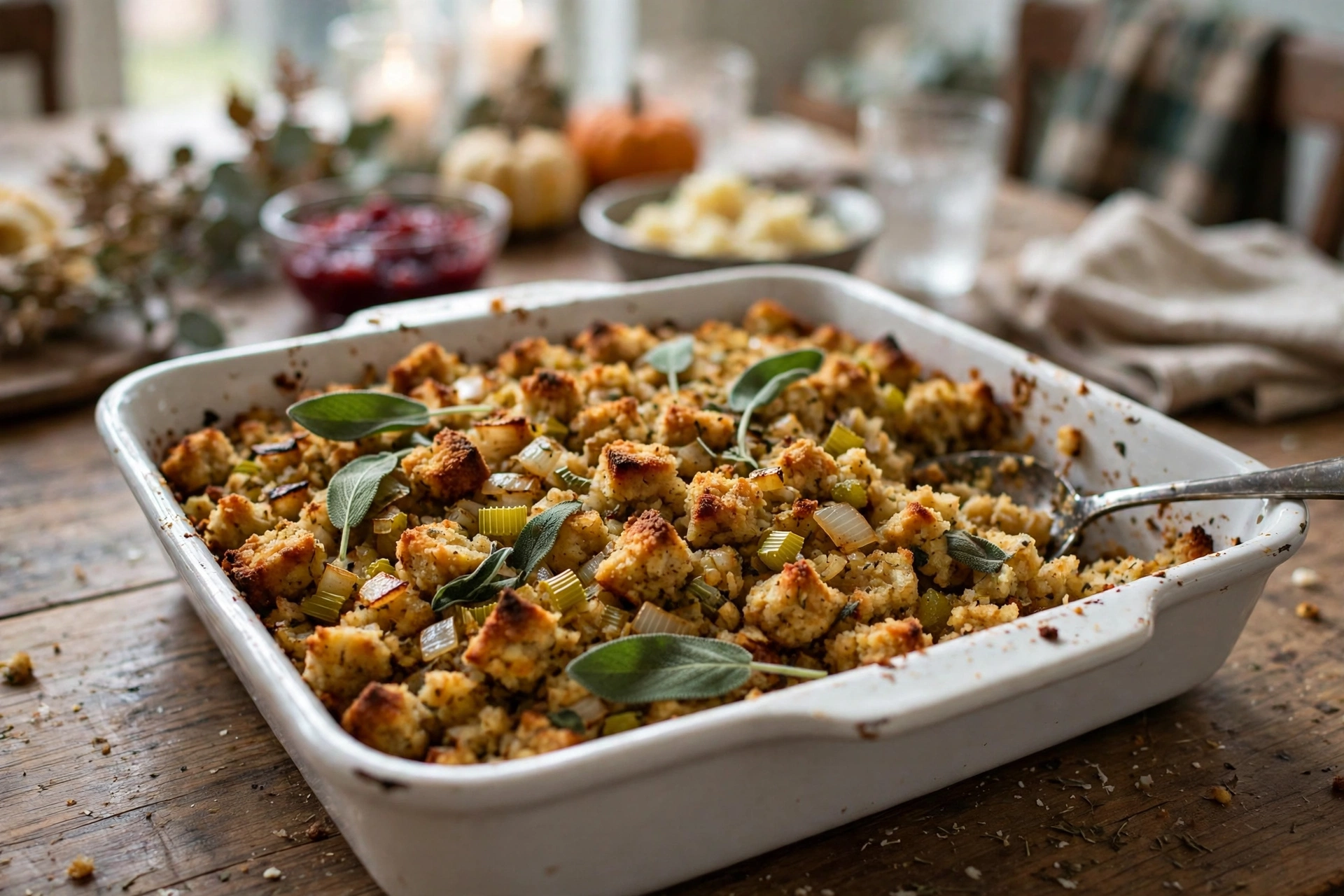
Why You’ll Love This Classic Thanksgiving Stuffing
- Never soggy, guaranteed: The dry-bread method, gradual broth addition, and the squeeze test make gluey stuffing physically impossible.
- Crispy top, custardy middle: Baking in a dish (not inside the bird) gives you golden, crunchy edges all around and a soft savory center — the best of both textures in every serving.
- Classic flavor, no shortcuts: Real butter, fresh sage, thyme, and rosemary, and slow-sautéed onion and celery — the exact flavor profile Thanksgiving stuffing is supposed to have.
- Make-ahead friendly: Assemble the whole pan a day ahead and refrigerate; bake it fresh while the turkey rests. One less thing to juggle on the big day.
- Scales for any crowd: The formula works for 6 people or 24 — just scale the bread and broth in the same ratio and add a second pan.
Ingredients You’ll Need
Every ingredient here does real work. There are no fillers in classic stuffing — bread for structure, butter for richness, aromatics for depth, herbs for that holiday perfume, and eggs plus broth to bind it all into a sliceable, scoopable pan.
Bread: 1 lb Day-Old Bread, Cut into 3/4-Inch Cubes (about 14–16 cups)
This is the ingredient the entire recipe stands or falls on. Use 1 pound of sturdy white bread — a plain sandwich loaf, Italian bread, or a rustic white — cut into rough 3/4-inch cubes. Day-old or stale bread is the goal: as bread stales, its starches firm up and it absorbs liquid slowly instead of collapsing into mush. If your bread is fresh, you will dry the cubes in a 300°F oven for 10–15 minutes first (step 1 below). Avoid soft, airy sandwich bread that compresses when you squeeze it, and avoid heavily flavored breads (rye, sourdough-with-inclusions) — their flavors fight the classic profile. A 12–14 ounce bag of plain, unseasoned store-bought dry stuffing cubes is a perfectly fine substitute and needs no pre-drying.
Unsalted Butter (1 cup / 2 sticks)
Two full sticks of unsalted butter — this is a holiday dish, and butter is doing triple duty: sautéing the vegetables, coating every bread cube in richness, and browning the top to a crisp finish. Unsalted matters because you are seasoning a whole pan of bread; salted butter plus broth plus added salt stacks up fast. Melt it slowly over medium heat — browned butter is not the goal here; you want it just melted and foamy so the vegetables soften gently in it.
Yellow Onion (2 cups diced, about 2 medium)
Two cups of diced yellow onion — roughly two medium onions — is the savory backbone of the dish. Sautéed slowly in the butter for 8–10 minutes, the onion turns sweet and translucent, building the deep savory base that makes stuffing taste like stuffing. Dice it to about 1/4-inch so it softens fully and distributes evenly through the bread cubes. Sweet onions work too; red onions are fine but will tint the dish slightly purple.
Celery (1 1/2 cups diced, about 4 stalks)
A cup and a half of diced celery — about four stalks — adds the clean, vegetal crunch-note that keeps the stuffing from tasting heavy. Like the onion, it goes into the butter first and softens until tender. Slice the stalks lengthwise once or twice before dicing so the pieces are small and even. Celery leaves, if your bunch has them, can be chopped and added along with the herbs for extra flavor — do not throw them away.
Garlic (2 cloves), Minced
Two cloves of minced garlic go in during the last minute of sautéing, just long enough to turn fragrant without browning. Garlic is not traditional in every family’s stuffing, but a small amount deepens the savory base without announcing itself. Keep it to two cloves — more starts to compete with the sage and thyme, which should stay the stars.
Fresh Herbs: Sage, Thyme, and Rosemary
Two tablespoons of chopped fresh sage, 1 1/2 tablespoons of chopped fresh thyme leaves, and 1 1/2 tablespoons of chopped fresh rosemary. This is the classic Thanksgiving herb trio, and fresh is strongly preferred — dried herbs are concentrated and can taste dusty or bitter at these quantities, and the fresh oils are what make the kitchen smell like the holiday. Strip thyme and rosemary leaves from their woody stems before chopping; sage leaves chop easily. If you must use dried, use one-third the amount (see Substitutions).
Fresh Parsley (2 tablespoons, chopped)
Two tablespoons of chopped fresh flat-leaf parsley, added off the heat at the end. Parsley brings a fresh, bright note that lifts the whole dish and adds little flecks of green color against the golden bread. Flat-leaf (Italian) parsley is preferred over curly for its cleaner flavor. This one is technically optional, but the dish looks and tastes noticeably better with it.
Low-Sodium Chicken or Turkey Broth (2 1/2 to 3 1/2 cups)
The liquid that turns bread cubes into stuffing. Start with 2 1/2 cups and add up to 3 1/2 cups gradually, judging by the squeeze test — different breads absorb at different rates, which is exactly why a fixed amount is a trap. Low-sodium is important: regular broth plus the salt you add can push the dish over the edge, and you cannot un-salt a baked pan. Turkey broth is the dream pairing if you have it (homemade turkey stock from the neck and giblets is perfect); good chicken broth is a fine stand-in. Warm the broth slightly before adding so it absorbs more evenly.
Large Eggs (2), Beaten
Two large eggs, beaten in a bowl before being whisked into the broth. The eggs are the binder — their protein sets during baking and gives the stuffing its sliceable, custardy structure instead of a loose pile of wet bread. This is what separates great stuffing from bread pudding’s sad cousin. Whisk them into the broth (not straight onto hot vegetables) so they distribute evenly without scrambling.
Kosher Salt (1 1/2 teaspoons) and Black Pepper (1 teaspoon)
A teaspoon and a half of kosher salt and a teaspoon of freshly ground black pepper, whisked into the broth-egg mixture. Taste the mixture before it goes into the oven — it should taste well-seasoned but not salty, because the flavors concentrate slightly as the liquid reduces in baking. If you used store-bought stuffing cubes that already contain salt, start with 1 teaspoon and adjust.
Poultry Seasoning (1 teaspoon, optional)
One teaspoon of poultry seasoning — the classic blend of sage, thyme, marjoram, and a whisper of nutmeg — reinforces the holiday flavor profile. It is optional because the fresh herbs already carry the dish, but many families consider it non-negotiable for “real” Thanksgiving stuffing. If you add it, you can reduce the fresh sage by half a tablespoon.
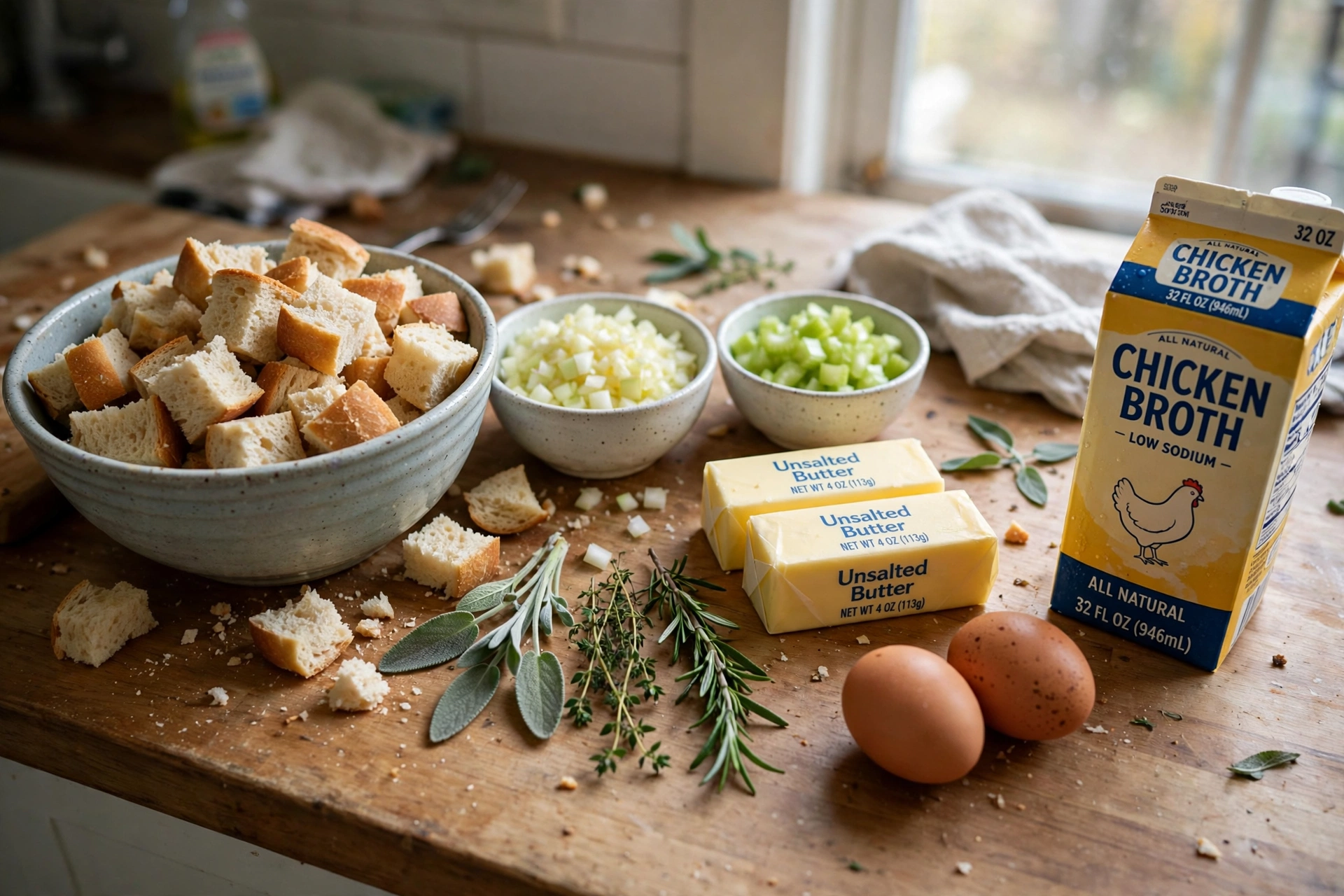
Recommended Equipment
- 9×13-inch baking dish (ceramic or glass; metal works but check browning earlier)
- Large rimmed baking sheet (for drying fresh bread cubes)
- Large skillet (for sautéing the onion, celery, and garlic in butter)
- Extra-large mixing bowl (the tossing step needs room — a too-small bowl crushes the cubes)
- Whisk and a large spoon or spatula
- Aluminum foil (for covering the dish during the first bake)
- Instant-read thermometer (to confirm 165°F in the center)
How to Make Classic Thanksgiving Stuffing
1. Dry the bread cubes (if using fresh bread)
Preheat the oven to 300°F (150°C). Spread the bread cubes in a single layer on a large rimmed baking sheet and bake for 10–15 minutes, tossing once halfway, until they feel dry and lightly crisp on the outside but are not browned. Let them cool completely. Skip this step if you are using day-old/stale bread or store-bought dry stuffing cubes. This is the single most important step for never-soggy stuffing — dry cubes absorb the broth gradually and hold their shape; fresh cubes absorb it instantly and collapse.
2. Sauté the onion and celery in butter
In a large skillet over medium heat, melt the 1 cup of butter. Add the diced onion and celery with a pinch of salt and cook, stirring occasionally, for 8–10 minutes, until the onion is soft and translucent and the celery is tender. Do not rush this with high heat — browned, crispy vegetables give a different (harsher) flavor than soft, sweet ones. This slow sauté builds the entire savory foundation of the dish.
3. Bloom the garlic and fresh herbs
Add the minced garlic, chopped sage, thyme, and rosemary to the skillet and cook, stirring constantly, for 1 minute until fragrant. The hot butter wakes up the herbs’ essential oils — you will smell the moment it happens. Remove the skillet from the heat and stir in the chopped parsley. Let the mixture cool for 5 minutes so it does not scramble the eggs in the next step.
4. Whisk the broth, eggs, and seasonings
In a large measuring cup or bowl, whisk together 2 1/2 cups of the low-sodium broth, the 2 beaten eggs, the kosher salt, black pepper, and the poultry seasoning (if using). Taste it — it should taste pleasantly seasoned, like a good soup. Remember you will add up to 1 more cup of broth later if the bread needs it, so do not over-salt now.
5. Toss the bread with the buttered vegetables
Place the dry bread cubes in your largest mixing bowl. Pour the warm butter-vegetable-herb mixture over the top and toss gently with a large spoon or your hands, turning the cubes so every one picks up a coating of butter and vegetables. Be gentle — the goal is coated cubes, not crushed crumbs. Every cube should glisten slightly.
6. Add the broth mixture gradually — the squeeze test
Pour about two-thirds of the broth-egg mixture over the bread and toss gently. Let it sit for 5 minutes so the bread absorbs the liquid, then toss again. Now do the squeeze test: pick up a handful and squeeze. The bread should clump together and hold its shape, but no liquid should drip out. If it crumbles apart, add more broth a half-cup at a time, tossing and waiting a few minutes between additions, until it passes the test. Most breads land between 2 1/2 and 3 1/2 cups total. When in doubt, err on the slightly drier side — you can always spoon a little warm broth over the baked stuffing, but you cannot fix a soggy pan.
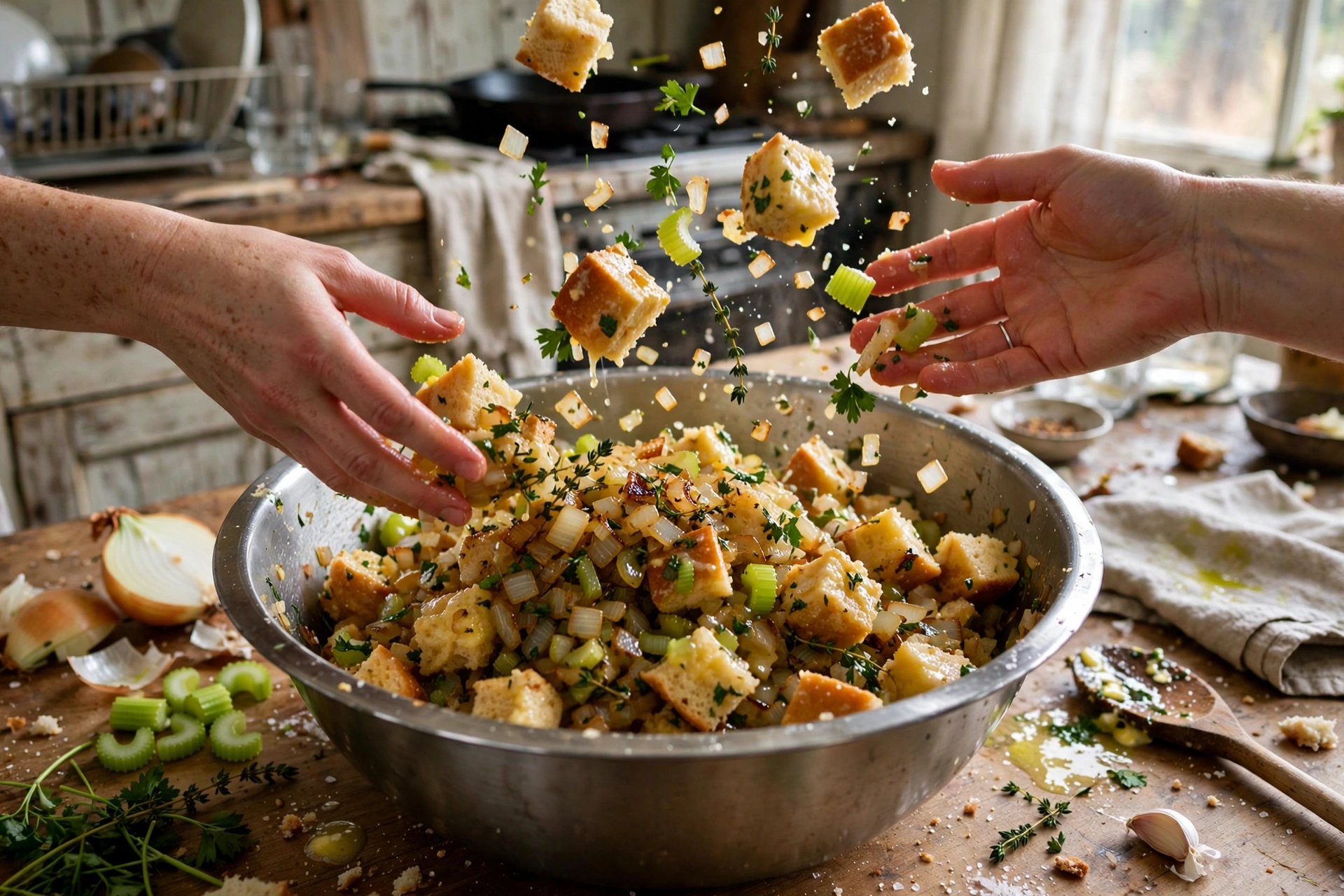
7. Transfer to the baking dish and bake covered
Preheat the oven to 350°F (175°C) if it is not already on. Grease the 9×13 baking dish with butter. Transfer the stuffing mixture to the dish and spread it in an even layer — do not pack it down; a loose fill bakes up lighter. Cover tightly with aluminum foil and bake for 30 minutes. The covered phase steams the interior to a soft, custardy set.
8. Bake uncovered until golden and crisp
Remove the foil and continue baking for 15–20 minutes, until the top is deeply golden and crisp and the center reads 165°F (74°C) on an instant-read thermometer. The uncovered phase is what creates the crunchy, caramelized top that everyone fights over. If the top is browning too fast before the center is set, tent it loosely with foil for the remaining time.
9. Rest 10 minutes and serve
Let the stuffing rest for 10 minutes before serving. This short rest lets the egg binder finish setting so the stuffing scoops out in neat, sliceable portions instead of falling apart. Serve hot, straight from the dish.
Pro Tips for Never-Soggy Stuffing
- The squeeze test is the whole recipe. Forget fixed broth amounts — different breads absorb wildly different quantities. A handful of the mixture should clump when squeezed but never drip. Drier is safer than wetter: you can moisten a finished pan with warm broth, but you cannot rescue a soggy one.
- Dry bread is non-negotiable. Fresh, soft cubes turn to mush; stale or oven-dried cubes absorb gradually and hold their edges. When in doubt about whether your bread is stale enough, give it the 300°F oven treatment — 10 minutes of insurance.
- Let the bread rest after adding broth. Bread absorbs liquid over several minutes, not instantly. Toss, wait five minutes, toss again, then judge. Judging too early leads to adding too much broth, which is how soggy stuffing happens.
- Do not pack the baking dish. Spread the mixture loosely and evenly. Packed stuffing steams instead of baking, and the center never gets the light, custardy texture you want. An even, loose layer also means more surface area for crispy edges.
- Eggs are the binder — do not skip them. The two beaten eggs set during baking and give the stuffing its sliceable structure. Without them you get seasoned wet bread, not stuffing. Whisk them into the (cooled slightly) broth so they distribute evenly.
- Bake it in a dish, not in the bird. Stuffing baked inside a turkey has to reach 165°F in its center to be safe, which almost always means overcooking the bird or serving underdone stuffing. A separate dish is safer, gives you crispy edges on all sides, and frees the oven timing from the turkey’s schedule. If you love the flavor of bird-baked stuffing, spoon some of the turkey’s pan drippings over the finished dish.
- 165°F is the doneness number. The center of the pan must reach 165°F (74°C) because the stuffing contains eggs. An instant-read thermometer takes the guesswork out — check the deepest part of the dish.
Stuffing vs. Dressing: What’s the Difference?
Stuffing and dressing are the same dish with two names. Technically, stuffing is cooked inside the bird and dressing is baked in a separate dish. In the South it is almost always called dressing no matter how it is cooked, while in much of the Northeast and Midwest, stuffing is the everyday word for both. This recipe is baked in a dish, so by the strict definition it is a dressing, but it delivers the exact flavor and texture everyone means by classic Thanksgiving stuffing. What matters at the table is not the name. It is the dry bread, the gradual broth, and the squeeze test.
Variations
Sausage and Apple Stuffing
Brown 1 pound of bulk breakfast sausage (or Italian sausage with the casings removed) in the skillet before the butter step; remove it with a slotted spoon, then proceed with the butter and vegetables in the rendered fat (reduce the butter to 1/2 cup). Fold the cooked sausage and 1 large diced tart apple (Honeycrisp or Granny Smith) in with the bread cubes. The sausage adds richness and the apple adds bright, sweet contrast. Increase the baking time by about 5 minutes.
Cornbread Stuffing (Southern Style)
Replace the white bread with 1 pound of day-old cornbread, crumbled into rough 3/4-inch pieces. Cornbread absorbs liquid faster, so start with only 2 cups of broth and add gradually. Add 1/2 cup of chopped pecans for crunch. The result is sweeter, denser, and unmistakably Southern — bake at the same 350°F, but check the center temperature at the 40-minute mark since cornbread sets faster.
Mushroom and Herb Stuffing (Vegetarian Showpiece)
Add 12 ounces of sliced cremini mushrooms to the skillet with the onion and celery and cook until deeply browned, about 12 minutes total. Use vegetable broth instead of chicken broth and add 1 tablespoon of soy sauce to the broth mixture for umami depth. This version is rich enough to stand as a vegetarian main alongside the sides.
Oyster Stuffing (Classic Coastal)
A traditional New England and Mid-Atlantic holiday classic: fold in 1 pint of shucked oysters (with their liquor) along with the bread cubes, and add 1/2 teaspoon of Old Bay seasoning to the broth mixture. The oysters bake into briny, savory pockets. Reduce the added salt to 1 teaspoon since oyster liquor is naturally salty.
Gluten-Free Stuffing
Use 1 pound of cubed gluten-free sandwich bread (stale it in the oven just like regular bread — GF bread actually dries beautifully). Everything else in the recipe is naturally gluten-free, but check your broth label to confirm. The texture is very close to the original, with slightly more delicate cubes — toss extra gently.
Slow Cooker Stuffing
Assemble the stuffing through step 6, then transfer it to a greased 6-quart slow cooker instead of the baking dish. Dot the top with a few extra pats of butter, cover, and cook on LOW for 3 to 4 hours, until the center reads 165°F and the edges are lightly set. This frees the oven for the turkey on the big day. The top will not brown the way the oven version does, so if crispy edges matter, move the finished stuffing to a buttered baking dish and broil it for 2 to 3 minutes before serving.
Ingredient Substitutions
- No fresh herbs? Use one-third the amount of dried: 2 teaspoons dried sage, 1 1/2 teaspoons dried thyme, 1 1/2 teaspoons dried rosemary. Crush dried herbs between your fingers as you add them to release their oils. Fresh is strongly preferred for the holiday perfume, but dried still produces a good pan of stuffing.
- No low-sodium broth? Regular broth works — reduce the added kosher salt to 1 teaspoon and taste the broth mixture before assembling. Never use water alone if you can avoid it; the broth is a major flavor contributor. In a pinch, dissolve 2 bouillon cubes in 3 cups of hot water and treat it as regular broth (reduce salt accordingly).
- No eggs / egg allergy? The eggs are structural, so this is the hardest substitution. A flax egg (1 tablespoon ground flaxseed + 3 tablespoons water per egg, rested 5 minutes) gives a workable bind, though the texture will be slightly less custardy. The dish should still reach 165°F in the center for food safety regardless.
- Dairy-free? Replace the butter with an equal amount of olive oil or a dairy-free butter alternative. Olive oil gives a slightly fruitier flavor that works well; use a neutral-flavored dairy-free butter for the closest match to the original.
- Different bread? Challah makes a rich, slightly sweet stuffing (reduce broth by about 1/2 cup — it absorbs fast). A rustic sourdough gives a tangy edge that pairs beautifully with sausage. Whatever you use, the rule is the same: it must be dry or dried, and you judge the broth by the squeeze test.
Dietary Notes
This recipe is vegetarian as written. It is not vegan (butter, eggs, chicken broth) — for a vegan version, use the dairy-free and egg substitutions above plus vegetable broth. It is not gluten-free as written, but the gluten-free variation above works well. It is naturally nut-free. The dish contains eggs and must reach 165°F in the center for food safety. For guests with poultry or egg allergies, this dish is not suitable.
Make-Ahead, Storage & Reheating
- Make ahead (the smart way): Assemble the stuffing completely through step 6 (in the greased baking dish, unbaked), cover tightly with plastic wrap or foil, and refrigerate for up to 24 hours. On Thanksgiving day, let the dish sit at room temperature for 30 minutes, then bake as directed — add 5–10 minutes to the covered baking time since it is starting cold. Do not assemble more than a day ahead; the bread keeps absorbing and the texture suffers.
- Bread cubes ahead: The dried bread cubes can be prepared up to 3 days ahead and stored in a paper bag or loosely covered bowl at room temperature (not plastic — they need air to stay crisp).
- Storage: Cool leftovers within 2 hours and refrigerate in an airtight container for up to 4 days. For longer storage, freeze in portion-sized freezer bags for up to 3 months.
- Reheating: The oven is the only way to revive stuffing properly. Place it in a buttered baking dish, sprinkle with a few tablespoons of broth, cover with foil, and bake at 350°F for 15–20 minutes until steaming; uncover for the last 5 minutes to re-crisp the top. Microwaving makes it gummy — avoid it if you can.
- Food-safety rules: The center of the baked stuffing must reach 165°F (74°C) — it contains eggs. Cool and refrigerate leftovers within 2 hours of baking. Reheat leftovers to steaming (165°F) before serving; reheat only once.
What to Serve With Classic Thanksgiving Stuffing
Stuffing is the team player of the Thanksgiving table — it belongs next to the bird and everything that goes with it. Pair it with our herb butter roast turkey — the juicy, golden centerpiece this stuffing was born to sit beside — and spoon warm pan gravy over both. For the full classic spread, add boursin mashed potatoes, green bean casserole, and cornbread casserole alongside a bright, tart baked cranberry sauce to cut through all the richness. Do not forget the fluffy dinner rolls for mopping up every last bit. Finish the meal with classic pumpkin pie — and the next day, fold the leftover stuffing into leftover turkey soup or press it into a waffle iron for the best Thanksgiving-leftover breakfast you have ever had.
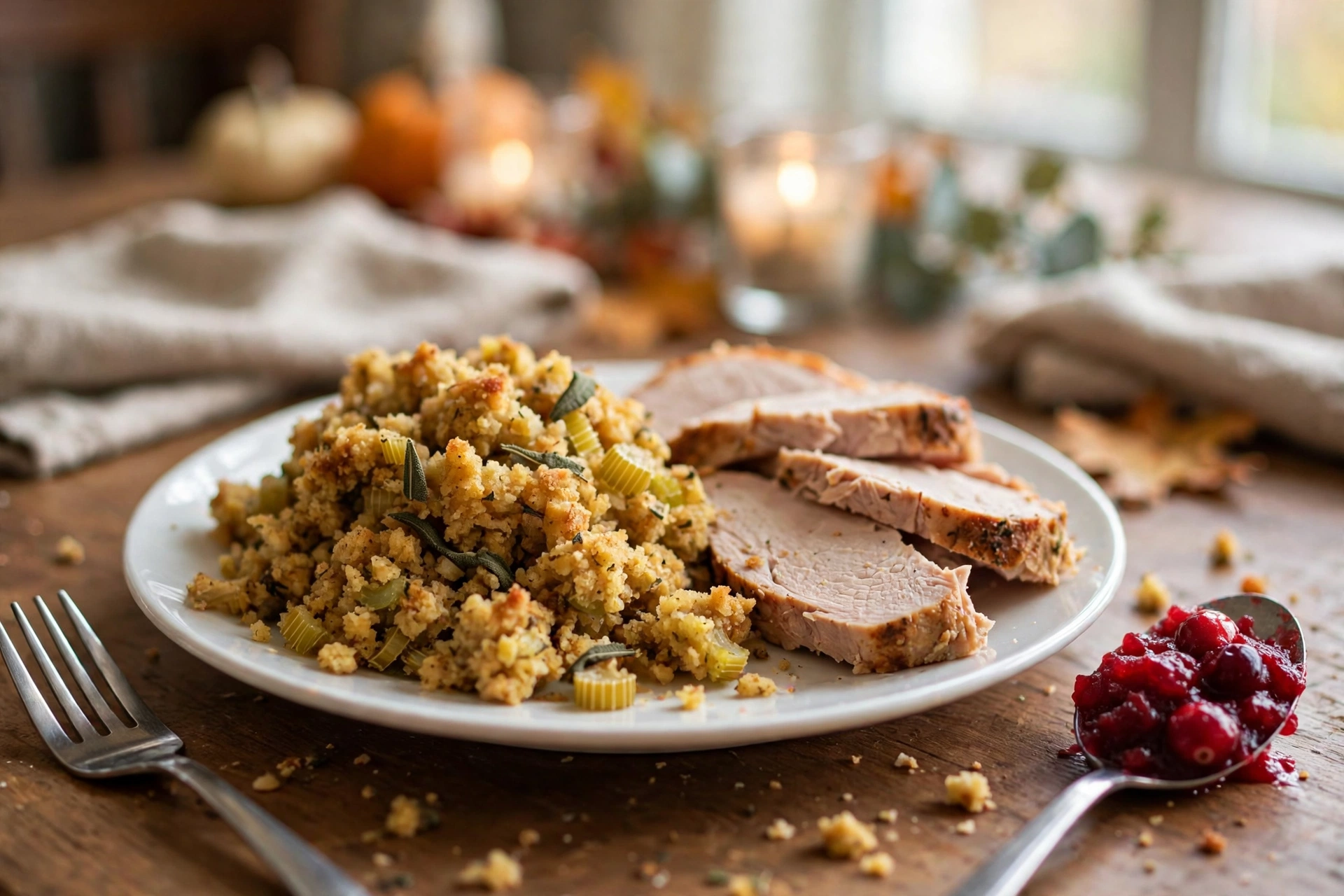
Recipe Notes
- Dry bread is the foundation — use day-old/stale bread, or dry fresh cubes at 300°F (150°C) for 10–15 minutes.
- Add broth gradually and judge by the squeeze test: the mixture should clump when squeezed but never drip liquid. Most breads need 2 1/2 to 3 1/2 cups total.
- Bake at 350°F (175°C) — do not set a higher temperature hoping for a crispier top; it dries the center before the top sets.
- Let the buttered vegetables cool 5 minutes before the eggs go near them.
- Do not pack the mixture into the dish — a loose, even layer bakes up lighter with more crispy surface.
- The center must reach 165°F (74°C); verify with an instant-read thermometer.
- Bake covered 30 minutes, then uncovered 15–20 minutes until deeply golden.
- Rest 10 minutes before serving so the egg binder sets for clean scoops.
- Assemble up to 24 hours ahead (unbaked, refrigerated); add 5–10 minutes to the covered bake when starting cold.
- Refrigerate leftovers within 2 hours; use within 4 days or freeze up to 3 months.
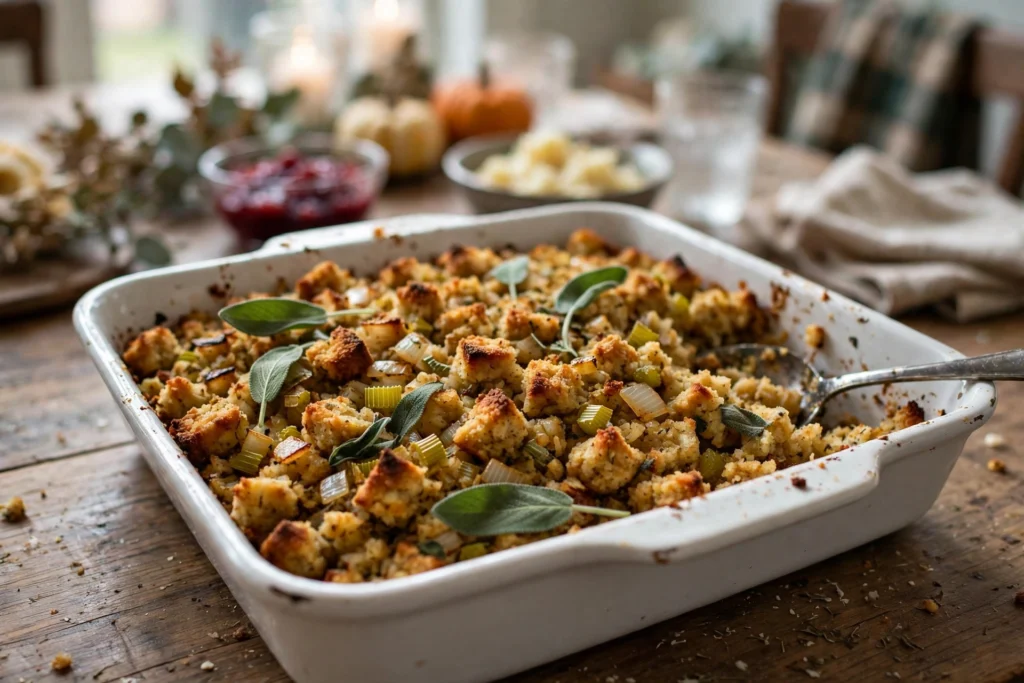

Classic Thanksgiving Stuffing — Buttery, Herby & Never Soggy
Description
Classic Thanksgiving stuffing with crispy golden edges and a soft, savory center — buttery bread cubes tossed with sautéed onion, celery, and fresh sage, thyme, and rosemary, bound with eggs and baked in a dish. The never-soggy method with the squeeze test.
Ingredients
Instructions
-
Dry the bread cubes (if using fresh bread)
Preheat the oven to 300°F (150°C). Spread the bread cubes in a single layer on a large rimmed baking sheet and bake 10–15 minutes, tossing once, until dry and lightly crisp but not browned. Cool completely. Skip if using stale bread or dry stuffing cubes.
-
Sauté the onion and celery in butter
Melt the butter in a large skillet over medium heat. Add the onion and celery with a pinch of salt and cook 8–10 minutes, stirring occasionally, until soft and translucent. Do not brown.
-
Bloom the garlic and fresh herbs
Add the garlic, sage, thyme, and rosemary; cook 1 minute, stirring constantly, until fragrant. Remove from heat, stir in the parsley, and cool 5 minutes.
-
Whisk the broth, eggs, and seasonings
Whisk 2 1/2 cups broth with the beaten eggs, kosher salt, black pepper, and poultry seasoning (if using). Taste — it should be pleasantly seasoned.
-
Toss the bread with the buttered vegetables
Place the bread cubes in a very large bowl. Pour over the butter-vegetable mixture and toss gently until every cube glistens.
-
Add the broth mixture gradually — the squeeze test
Pour about two-thirds of the broth mixture over the bread, toss, and rest 5 minutes. Squeeze a handful: it should clump and hold its shape with no liquid dripping out. Add more broth 1/2 cup at a time until it passes. Total is usually 2 1/2 to 3 1/2 cups.
-
Transfer to the baking dish and bake covered
Preheat the oven to 350°F (175°C). Grease a 9x13 baking dish, add the stuffing in a loose, even layer (do not pack), cover tightly with foil, and bake 30 minutes.
-
Bake uncovered until golden and crisp
Remove the foil and bake 15–20 minutes more, until the top is deeply golden and the center reads 165°F (74°C) on an instant-read thermometer.
-
Rest 10 minutes and serve
Rest 10 minutes before serving so the binder sets; serve hot from the dish.
Nutrition Facts
Servings 12
- Amount Per Serving
- Calories 260kcal
- % Daily Value *
- Total Fat 14g22%
- Saturated Fat 8g40%
- Cholesterol 60mg20%
- Sodium 560mg24%
- Total Carbohydrate 35g12%
- Dietary Fiber 2g8%
- Sugars 4g
- Protein 6g12%
* Percent Daily Values are based on a 2,000 calorie diet. Your daily value may be higher or lower depending on your calorie needs.
Note
- Bake at 350°F (175°C) — 30 minutes covered, then 15–20 minutes uncovered until deeply golden.
- Start with dry bread (day-old/stale, or dried 10–15 minutes at 300°F / 150°C). Fresh soft bread = soggy stuffing.
- Add broth gradually and use the squeeze test: the mixture should clump when squeezed but never drip. Err on the drier side.
- The center must reach 165°F (74°C) — the stuffing contains eggs. Verify with an instant-read thermometer.
- Cool the buttered vegetables 5 minutes before the eggs go near them so they do not scramble.
- Do not pack the mixture into the dish; a loose, even layer bakes up lighter.
- Best season: Fall / Thanksgiving.
- Cool and refrigerate leftovers within 2 hours; use within 4 days or freeze up to 3 months.
- Nutrition is an estimate calculated from this recipe's listed ingredients and will vary with the bread and broth used.